


- Dubai ranked as the most digitally dependent city in 2025, excelling in CCTV coverage, internet speed, and digital public services, according to ZeroBounce.
- Shanghai and Seoul followed in second and third place, with strong performances in pollution monitoring, transport digitization, and public Wi-Fi access.
A recent study by ZeroBounce has identified the world's ten most digitally dependent cities based on key digital infrastructure categories. The analysis assessed internet speed, public Wi-Fi availability, CCTV coverage, pollution monitoring, and digitized transportation systems.
Each category was scored out of 100, and a weighted average of these scores determined the final ranking.
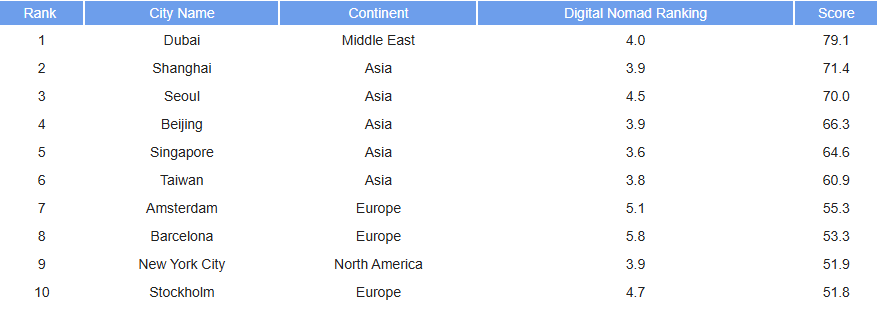
Dubai ranked as the most digitally dependent city in 2025, achieving a score of 79.1. The city has the highest global CCTV coverage (88.5) and ranks second in internet speed performance. It also performs well in online maintenance reporting.
Shanghai secured the second position with a score of 71.4. The Chinese city led in pollution monitoring (89.7), digitized transport infrastructure (87.5), and real-time traffic information (88.1). Its maintenance reporting system (84.5) outperformed Dubai’s by 8%.
Seoul ranked third with a score of 70. The South Korean capital stood out for its strong public Wi-Fi availability and high CCTV coverage (80.6). It also had a digital nomad ranking of 4.5, surpassing both Dubai and Shanghai.
Beijing took fourth place with a score of 66.3, excelling in pollution monitoring (86.5) and transport infrastructure digitization (83.7). Singapore followed in fifth place with a score of 64.6, performing well in CCTV coverage (80.8) and public Wi-Fi availability.
Amsterdam ranked seventh with a score of 55.3, the highest among European cities. It had one of the best digital nomad rankings (5.1) and a solid internet infrastructure. Barcelona, in eighth place with a score of 53.3, recorded the highest digital nomad ranking (5.8) among the top 10 cities.
New York City was the only North American city on the list, ranking ninth with a score of 51.9. It had nearly twice the CCTV coverage of Amsterdam (57.2 vs. 35.4) but lagged in digital transport efficiency compared to Barcelona.
Stockholm rounded out the top ten with a score of 51.8. The Swedish capital had strong internet connectivity (ranked 15th globally) and the highest digitized transport infrastructure score among European cities (70). However, its pollution monitoring score (57.8) was below the top 10 average.
Commenting on the findings, Brian Minick, Chief Operating Officer at ZeroBounce, stated:
“It’s fascinating to see the data ranking the cities with the strongest digital infrastructure around the world. This infrastructure not only improves transportation and public safety but also enhances access to essential services like healthcare and digital governance. Our study shows that cities in the Middle East and Asia lead in forward-thinking technology and thus streamline public services, improve mobility, and create safer, more connected environments.”
Edited by Harshajit Sarmah


