


The Middle East and North Africa (MENA) region, long synonymous with oil wealth and conservative financial stewardship, is quietly orchestrating a new symphony in the global investment arena.
In 2025, the region’s sovereign wealth funds (SWFs) are no longer content to play second fiddle in the digital revolution.
Instead, they are stepping onto the Web3 stage, tuning their instruments for a performance that could redefine the region’s economic future.
From Oil Barrels to Digital Blocks
For decades, MENA’s SWFs - such as Saudi Arabia’s Public Investment Fund (PIF), Abu Dhabi’s Mubadala Investment Company, and the Qatar Investment Authority - were guardians of generational wealth, favouring stable assets like real estate, infrastructure, and blue-chip equities.
But as the world’s economic climate shifts and oil’s dominance wanes, these funds are pivoting.
The new refrain is digital: Web3, blockchain, and decentralised finance are no longer fringe curiosities but central to future-proofing national portfolios.
This transformation is a matter of diversification. and also a calculated bet that the next wave of global growth will be written in code, not crude.
The Numbers Behind the Narrative
MENA SWFs are expected to become even more active in 2025, driven by capital inflows from higher oil prices and a strategic mandate to modernise their asset allocations.
The region’s largest fund, Saudi Arabia’s PIF, crossed the $1 trillion mark in assets in 2024, even as it reported a 60% drop in net profit due to global headwinds, signalling a willingness to weather short-term volatility for long-term gains.
But the most telling sign of change is in the digital asset space. Mubadala, Abu Dhabi’s sovereign wealth fund, recently disclosed a $408.5 million stake in BlackRock’s iShares Bitcoin Trust ETF as of March 2025, up from $436 million at the end of 2024.
This is a signal flare to global markets that MENA’s institutional capital is ready to embrace regulated exposure to crypto assets.
Charting the Shift
MENA SWFs’ investment allocations in 2025 reveal a nuanced strategy:
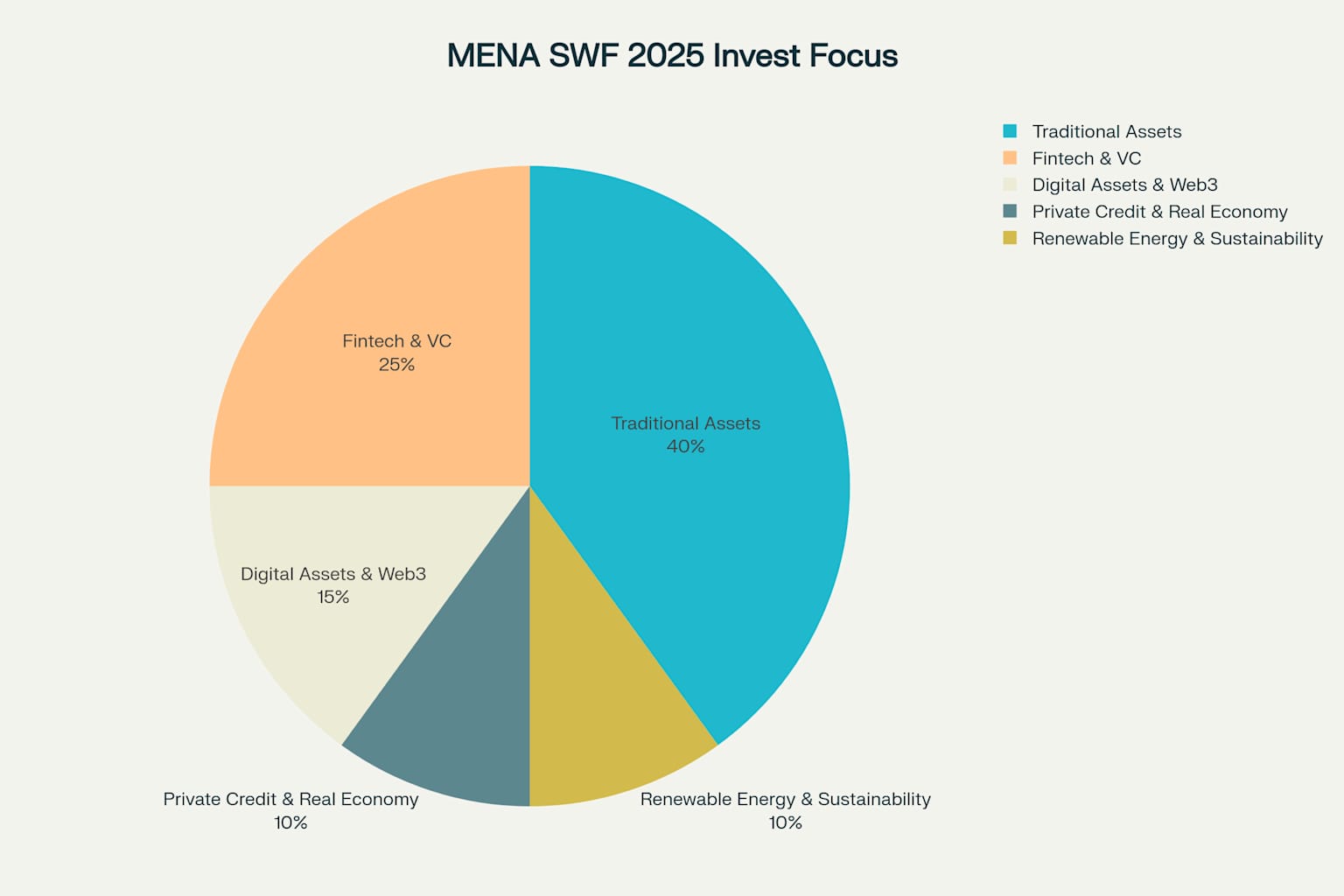
MENA Sovereign Wealth Funds Investment Focus and Recent Trends in Web3 and Fintech Funding (2024-2025)
This distribution reflects a deliberate move away from the old orthodoxy, with digital assets and Web3 now commanding a meaningful share of the portfolio.
The Web3 Experiment: Calculated Curiosity or Bold Bet?
What makes MENA’s approach to Web3 distinct is its pragmatism. Rather than diving headlong into the wilds of unregulated crypto, regional SWFs are favouring exchange-traded products (ETPs) and ETFs.
Mubadala’s increased stake in Bitcoin ETFs is emblematic of this trend, providing exposure to digital assets while sidestepping the reputational and compliance risks of direct crypto holdings.
DeFi Technologies, for example, has expanded into Dubai, launching a trading desk at the Dubai Multi Commodities Centre and offering over 65 digital asset ETPs, with plans to reach 100 by year-end.
The UAE’s regulatory clarity and openness to innovation have made it a magnet for both regional and international capital.
Saudi Ambition, Emirati Execution
The UAE and Saudi Arabia are emerging as the twin engines of MENA’s Web3 push. In April 2025 alone, MENA startups raised $228.4 million across 26 deals - a 105% increase from March, with fintech and Web3 ventures leading the charge.
Saudi Arabia’s PIF is not far behind, leveraging its scale to ink $12 billion in investment agreements with U.S. asset managers and supporting local capital markets.
This surge reflects a deeper shift in investor psychology. Where once risk aversion reigned, there is now a willingness to experiment - albeit within guardrails.
The region’s SWFs are acting less like cautious custodians and more like venture catalysts, seeking out the next Tabby or Tamara (regional fintech unicorns) and even exploring digital asset mining partnerships.
Challenges and Opportunities
Yet, the path is not without its potholes. Political uncertainties, regulatory flux, and the spectre of global economic slowdown loom large. SWFs must balance their newfound appetite for innovation with the imperative to preserve national wealth.
The challenge is to avoid the siren song of hype and focus on investments that offer both technological promise and real-world utility.
But if the past year is any indication, MENA’s sovereign investors are learning fast. They are not merely testing the waters; they are building bridges, laying foundations, and, in some cases, charting new courses entirely.
The region’s embrace of Web3 is the first movement in what could be a generational transformation.
The Desert Blooms Digital
In the grand tapestry of global finance, the MENA region's sovereign wealth funds are weaving new patterns: bold, intricate, and unmistakably digital.
Their foray into Web3 is a hedge against obsolescence and a declaration that the region intends to help write the next chapter of economic history.
As the sun rises on this new era, the question is not whether MENA’s SWFs will shape the future of Web3, but how deeply their influence will be felt across markets, industries, and generations to come.
Edited by Annette George


