


- AI detection tools have flagged the Central African Republic President’s video announcing a national memecoin as a possible deepfake, raising concerns over its legitimacy.
- The memecoin, launched on Solana’s Pump.fun, briefly surged to a $527 million market cap, though questions about its domain registration and liquidity remain.
- The controversy follows previous CAR crypto initiatives, including the adoption of Bitcoin as a legal tender in 2022 and the launch of Sango Coin.
A video statement from Central African Republic (CAR) President Faustin-Archange Touadéra announcing the launch of a national memecoin has been flagged as potentially AI-generated by at least two deepfake detection tools.
The announcement, posted on Touadéra’s official X (formerly Twitter) account on Feb. 9, described the token as an "experiment" aimed at fostering national development and increasing the country’s global visibility.
Today, we are launching $CAR - an experiment designed to show how something as simple as a meme can unite people, support national development, and put the Central African Republic on the world stage in a unique way.
— Faustin-Archange Touadéra (@FA_Touadera) February 9, 2025
Contract: 7oBYdEhV4GkXC19ZfgAvXpJWp2Rn9pm1Bx2cVNxFpump
The CAR memecoin, launched on the Solana-based platform Pump.fun at 10:25 p.m. UTC on Feb. 9, quickly surged to a peak valuation of $527 million, according to data from DexScreener. The token’s official website features a video of President Touadéra discussing the project, along with a tokenomics breakdown outlining its supply distribution.
Deepware, a widely used AI detection tool, flagged the video as suspicious, with one of its models assigning an 82% probability that it was a deepfake. Other AI detection models, including Avatrify and Deepware’s proprietary tool, did not identify the video as manipulated.
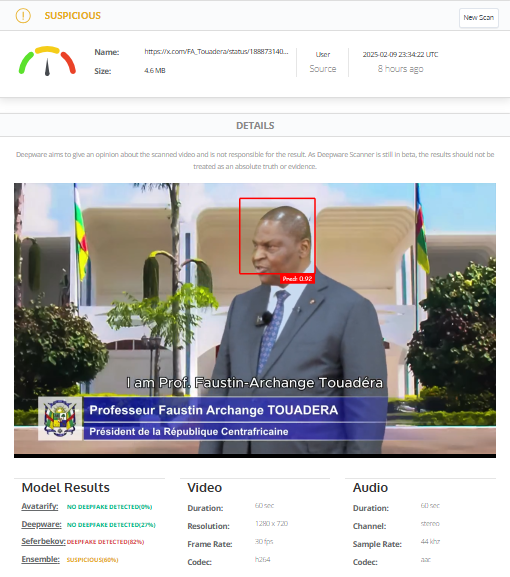
The conflicting results have fueled speculation, with some suggesting the token launch is genuine, while others believe it could be the result of a security breach involving the president’s X account.
Further skepticism emerged when cybersecurity researcher Yokai Ryujin pointed out irregularities in the domain registration of the project’s official website. In a Feb. 10 post, he noted that the domain was registered only three days before the announcement, stating that the process “did not look like what a president or country would do.”
‼️ CT and my crew be cautious about $CAR
— Yokai Ryujin (@YokaiCapital) February 9, 2025
domain registered on namecheap 3 days ago...
does not look like what president or a country would do...
do not let liquidity be sucked out from the ecosystem...
NFA - I could be very well wrong... but 🚩 pic.twitter.com/KnDaIywTXl
Domain provider Namecheap later confirmed that it had “suspended the abusive service,” yet the website remained accessible at the time of publication.
We have suspended the abusive service. Thank you.
— Namecheap.com (@Namecheap) February 10, 2025
Concerns also stem from the language used in the announcement. Pseudonymous user Crypto Dreamer noted on X that the tweet was written solely in English, despite French being the official language of the CAR. They also questioned the timing of the launch, which took place at midnight local time.
In response to growing doubts, the official X account linked to the memecoin, @Carmeme_news, was suspended. President Touadéra stated that he was “working with X” to restore the page.
We are working with @X to get @CARMeme_News back as soon as possible.
— Faustin-Archange Touadéra (@FA_Touadera) February 9, 2025
Meanwhile, the token supply has been securely locked through @streamflow_fi, according to the distribution plan, emission groups, and release schedule detailed on our website.
The controversy comes amid a rise in social media account hacks, with recent incidents involving scammers taking control of accounts belonging to the former Malaysian prime minister and the Solana-based decentralized exchange aggregator Jupiter to promote fraudulent memecoins.
Despite the uncertainty surrounding the CAR memecoin, the Central African Republic has a history of engaging with cryptocurrency. In April 2022, the country adopted Bitcoin as legal tender and introduced Sango Coin, a government-backed cryptocurrency aimed at attracting foreign investment through citizenship incentives.
However, the legal tender status of Bitcoin and other cryptocurrencies was repealed in March 2023 following opposition from regional economic authorities.
According to Solscan data, the CAR memecoin’s distribution aligns with figures posted on its official website. One wallet holds 33.31% of the supply, while another contains 25%. Additional allocations include 9.81% and 8.39% held in separate wallets, one of which may be designated for charitable purposes.
However, despite a stated allocation of 20% of the token supply for liquidity, no liquidity pool has been established for the token so far, raising further concerns about the project’s legitimacy.
Edited by Harshajit Sarmah


